Director’s Message
Hans-Joachim Lehmler, PhD
Director
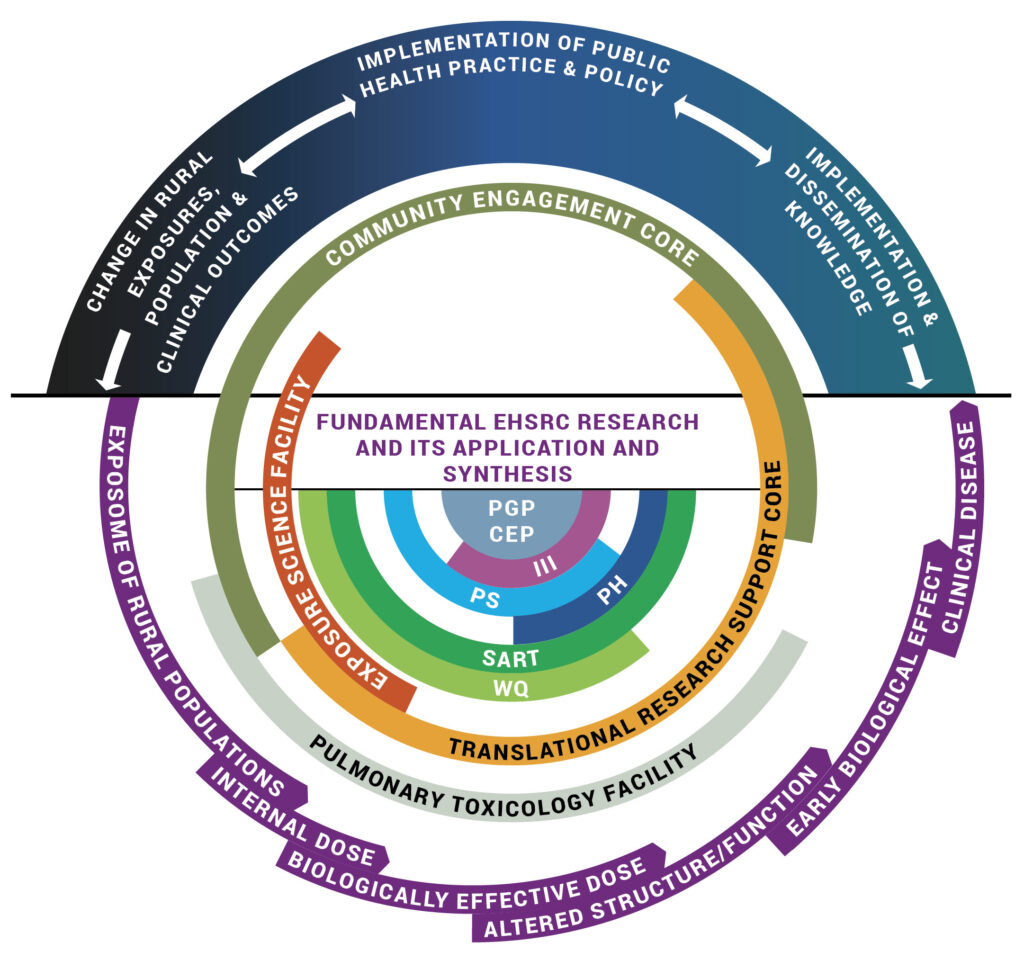
Welcome to the Environmental Health Sciences Research Center (EHSRC) website! As the EHSRC enters its 36th year of funding, we conjoin 25 other national environmental health sciences core centers funded by the NIEHS. Our distinction as a center among them is our focus on advancing and translating research that addresses environmental health problems across the urban-rural continuum. Rural America faces unique environmental challenges from exposure to farm chemicals, air and water pollution from livestock and agricultural production, rural manufacturing, and the green energy economy. The EHSRC is at the forefront of research in rural environmental health, determining the role of innate immunity and the inflammasome in lung disease; the role of the microbiome in health and disease; state-of-the-art biomedical imaging with advanced computational modeling to assess the effect of inhaled toxicants; and applications for distributed sensor networks and data analytics for exposure monitoring. Our interdisciplinary investigators apply innovations, for example, in advanced -omics technologies, population-based animal models, and advanced lung imaging, to advance this research.
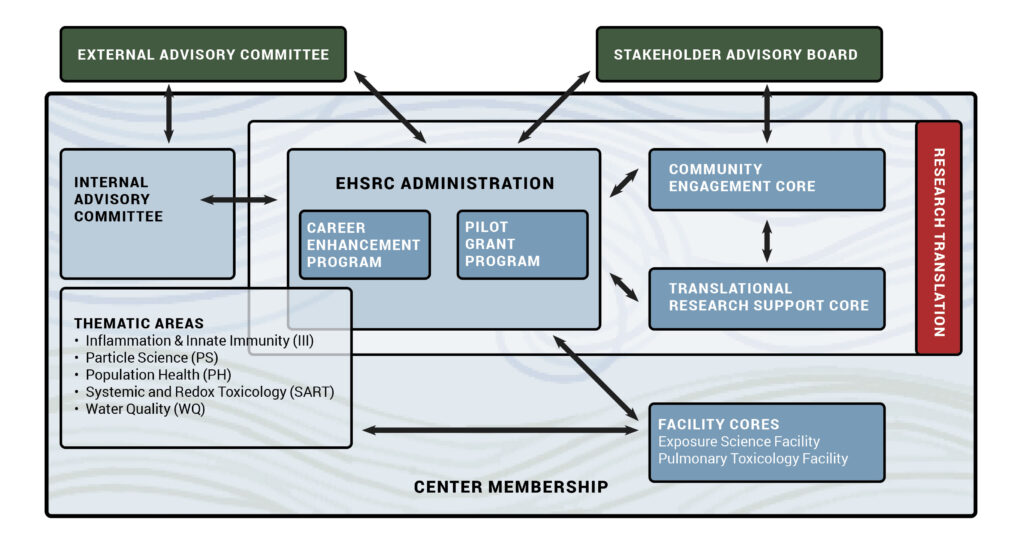
The research of the EHSRC is organized around its Thematic Areas and supported by three facilities, the Translational Research Support Core (TRSC), Exposure Science Facility (ESF), and Pulmonary Toxicology Facility (PTF). These facilities provide cost-effective and cutting-edge services and state-of-the-art equipment. An Administrative Core provides transformative leadership, leverages institutional support, and manages highly effective Pilot Grant and Career Enhancement Programs that provide resources and mentoring to advance the careers of promising and early-stage investigators. The Community Engagement Core engages the Center’s audiences to ensure the relevance of EHSRC research and, in collaboration with the TRSC, translates research to environmental public health.
EHSRC Strategic Vision
The EHSRC vision is to be the primary environmental health sciences (EHS) resource for improving the health of rural residents in the Midwest by stimulating and translating innovative environmental health sciences research. This is accomplished by enhancing the careers of Center investigators and through our translational research vision to translate new insights from rural exposures; population health; individual susceptibilities; and pathways of toxicity, disease, and repair to enhance environmental health literacy, public health practice, regulatory policy, new clinical treatments, and precision environmental health.
EHSRC Research Translation Vision
Our translational research vision is to translate new insights from rural exposures; population health; individual susceptibilities; and pathways of toxicity, disease, and repair to enhance environmental health literacy, public health practice, regulatory policy, new clinical treatments, and precision environmental health.
Center Theme, Goals and Specific Aims
Center Theme:
The overarching theme of the EHSRC is research and engagement addressing the adverse health effects of current and emerging environmental contaminants, especially among rural and agricultural populations. Following this overall theme, the EHSRC will pursue the following Goals and Aims to strengthen the environmental health sciences research capacity in the Midwest U.S. and beyond:
Goals and Specific Aims:
Goal 1) Enhance the effectiveness of environmental health sciences research and extend the focus of research in five Thematic Areas, including Inflammation and Innate Immunity, Nanoscience, Population Health, Systemic and Redox Toxicology, and Water Quality.
Aim 1. Build programmatic and scientific capacity by supporting three state-of-the-art Core Facilities to provide the latest research equipment, techniques, and expertise.
Aim 2. Operate a rigorous, competitive Pilot Grant Program (PGP) to develop new research initiatives, support the career enhancement of early-stage investigators, establish new collaborations, develop new research directions, and address the needs of our stakeholders.
Aim 3. Host thematic enhancement activities, such as seminars, Thematic Area meetings, and retreats, to promote interaction and generate innovative ideas among current and potential Center members.
Aim 4. Promote novel research directions for EHSRC investigators by building teams around grant solicitations and by establishing inter-center collaborations.
Goal 2) Recruit, mentor, and nurture a diverse group of investigators interested in the environmental health sciences, with an emphasis on recruiting and grooming future leaders in the field.
Aim 5. Maintain a formal Career Enhancement Program (CEP) that identifies promising early-stage investigators representing diverse backgrounds and provides mentoring, research or salary support, career enhancement opportunities, and the use of core facilities to advance their careers as environmental health scientists.
Aim 6. Recruit and support Associate Members and early-stage investigators to compete for the pilot grants to develop new research initiatives and preliminary data for full grant applications.
Aim 7. Provide training to enhance Center members’ knowledge of and comfort with community engagement.
Aim 8. Operate an Administrative Core that engages university officials, collegiate deans, and other leaders to leverage university-wide resources in support of the EHSRC’s recruiting and mentoring efforts.
Goal 3) Engage with communities and other audiences to translate research knowledge toward improving the health and environment of rural people in the Midwest and the nation.
Aim 9. Foster collaborative translational research among basic scientists, physician-researchers, and investigators engaged in population-based studies to broadly impact environmental, clinical, and public health.
Aim 10. Conduct workshops, public meetings, and other engagement programs, and produce science-based environmental health resources and knowledge relevant to the rural Midwest by engaging stakeholders.
Aim 11. Serve NIEHS, the region, and the nation as an authoritative body on issues related to rural environmental health and as a rapid responder for environmental disasters.