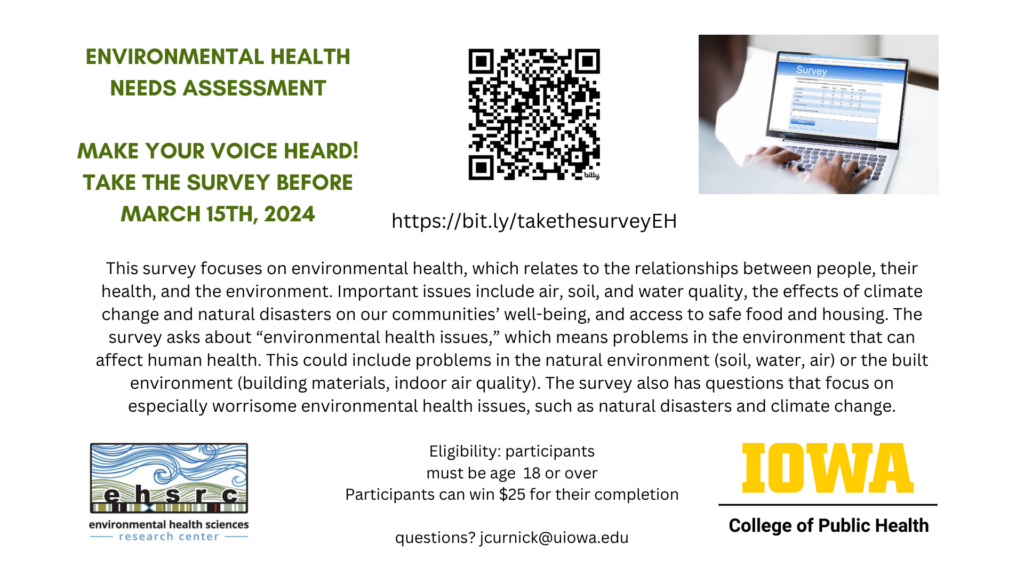
The Community Engagement Core has released a new fact sheet about health impacts of microplastics.
View the full packet and all of the individual fact sheets on the resources page.
Environmental Health Sciences Research Center
University of Iowa College of Public Health
The Community Engagement Core has released a new fact sheet about health impacts of microplastics.
View the full packet and all of the individual fact sheets on the resources page.
The Community Engagement Core conducted an Environmental Health Needs Assessment to drive our programming to meet the questions and concerns of our community members. The results are posted below:
Slides from IPHC Conference IPHC 2025
Due February 6th 2026 – The Science Cafe is a program that connects UI researchers and experts with Iowa community members. These one-hour events take place at a local coffee shop in Mt. Vernon, IA (about 30 mins from Iowa City) are structured around a presentation and group discussion about various environmental, health, and scientific topics.
https://uiowa.qualtrics.com/jfe/form/SV_bq1LoK0QzwWYV4W (Fill out this form by Feb 6th) Eligibility: Faculty, staff, and graduate students at the University of Iowa
The Science Cafes are usually on a weekday from 5-6 pm. The structure of the event is 30 min talk by presenter (no slides are used but there is a paper hand out), 25 min discussion/Q+A, Dr. Brandi Janssen facilitates the events.
Questions? Email Jackie Curnick jcurnick@uiowa.edu
Visit the science café webpage https://ehsrc.public-health.uiowa.edu/communityengagement/science-cafe/
Topics that have been directly requested by the Science Café participants on evaluations: (though you can propose any topic)
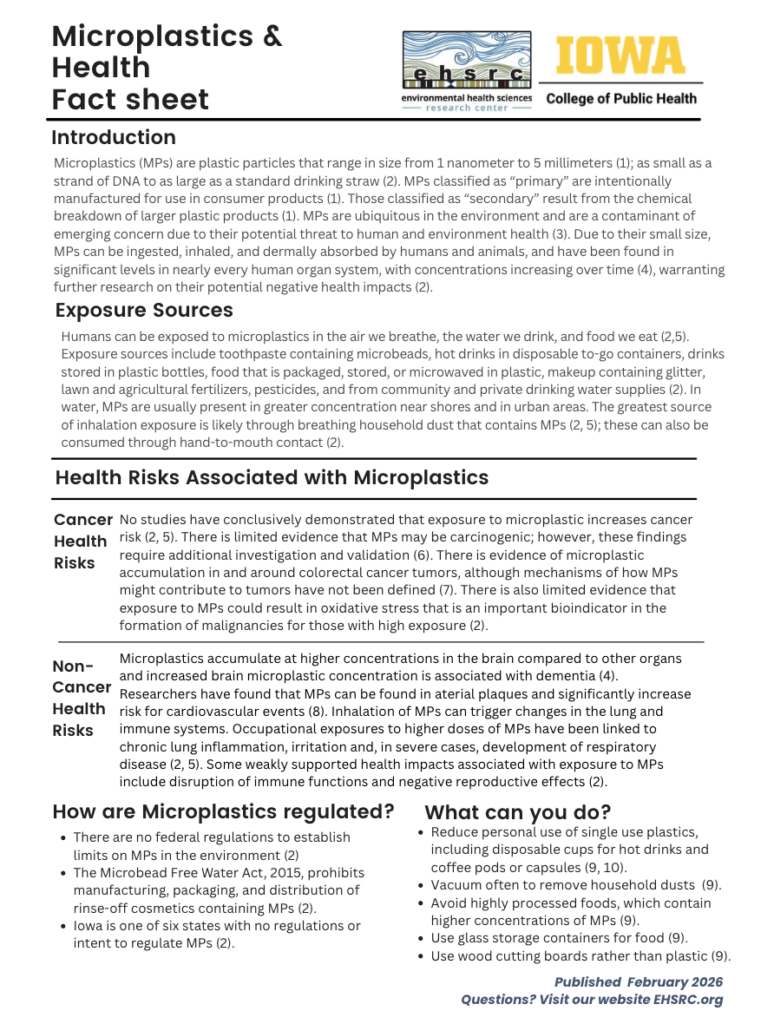
PFAS and TCE are the two newest fact sheets that have been released by the EHSRC. These resources cover different environmental contaminants and how they affect health (cancer and non-cancer health risks) and what people can do to protect themselves. View all of the fact sheets here on our resources page. The full packet is available as well as each individual contaminant (Arsenic, Atrazine, Glyphosate, Nitrate, PFAS, Radon, and TCE).
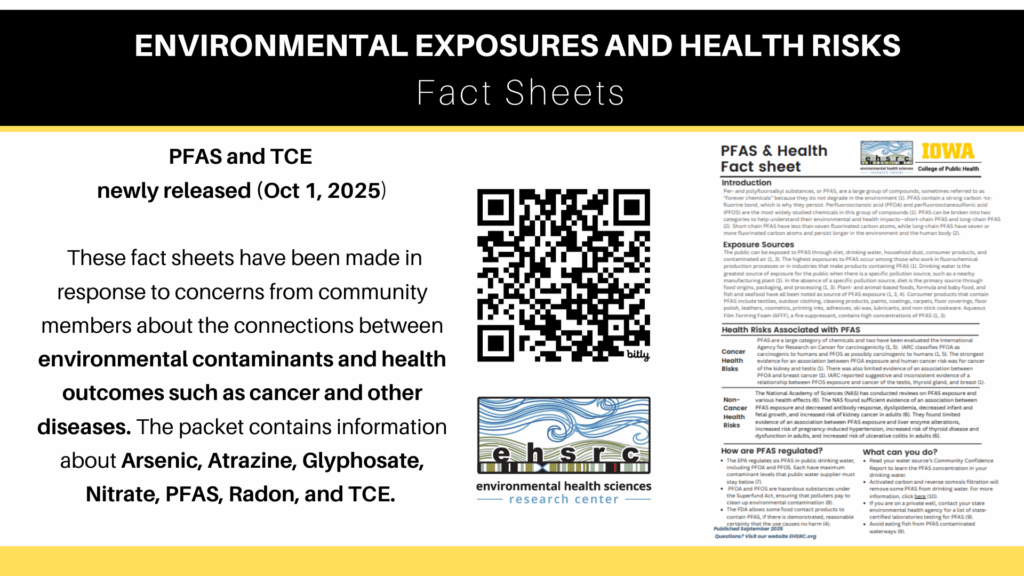
Due September 15, 2025
The Environmental Health Sciences Research Center (EHSRC) at the University of Iowa is pleased to announce funding available of up to $10,000 available to facilitate community engaged and translational research related to environmental health.
 The EHSRC has released a new fact sheet detailing its role in environmental health sciences research aimed at protecting Iowans’ health. Funded by the National Institute of Environmental Health Sciences, the EHSRC is the only environmental health research center in the Great Plains/Midwest region. We focus on pressing state and regional issues including:
Click here to view the fact sheet
Environmental health sciences research is an economic powerhouse in Iowa, with $2.38 in economic activity for every dollar invested. The economic benefits from EHSRC include:
The yearly training titled “Enhancing Your Research with Equitable Community Engagement” is seeking proposals for lightning talks (7-10 mins).
This call is open to anyone in the University of Iowa community (students, staff, faculty, post-docs, community partner) and the topic is community engagement in a Public Health project. The event will be the morning of June 25th.
Please submit your proposal using the qualtrics form by Monday April 21st. https://uiowa.qualtrics.com/jfe/form/SV_6ljGTFz3wLtLTng
Proposal components: Title of proposed talk, describe the project (200 words or less), and describe the community engagement component (100 words or less)
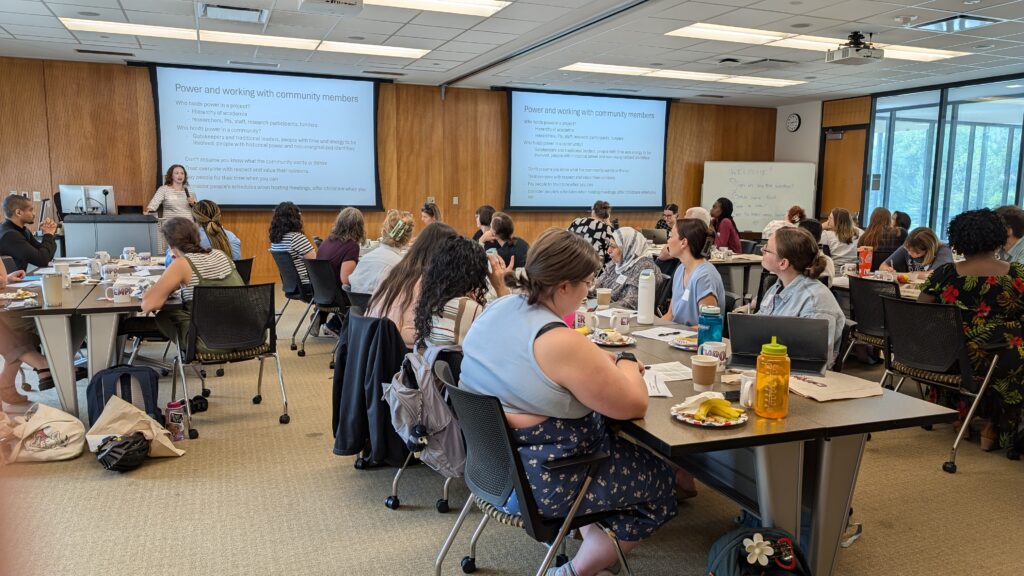
This event is sponsored by the Community Engagement Cores of the Environmental Health Sciences Research Center and Iowa Superfund Research Program.
Questions? Email Jackie Curnick at jcurnick@uiowa.edu
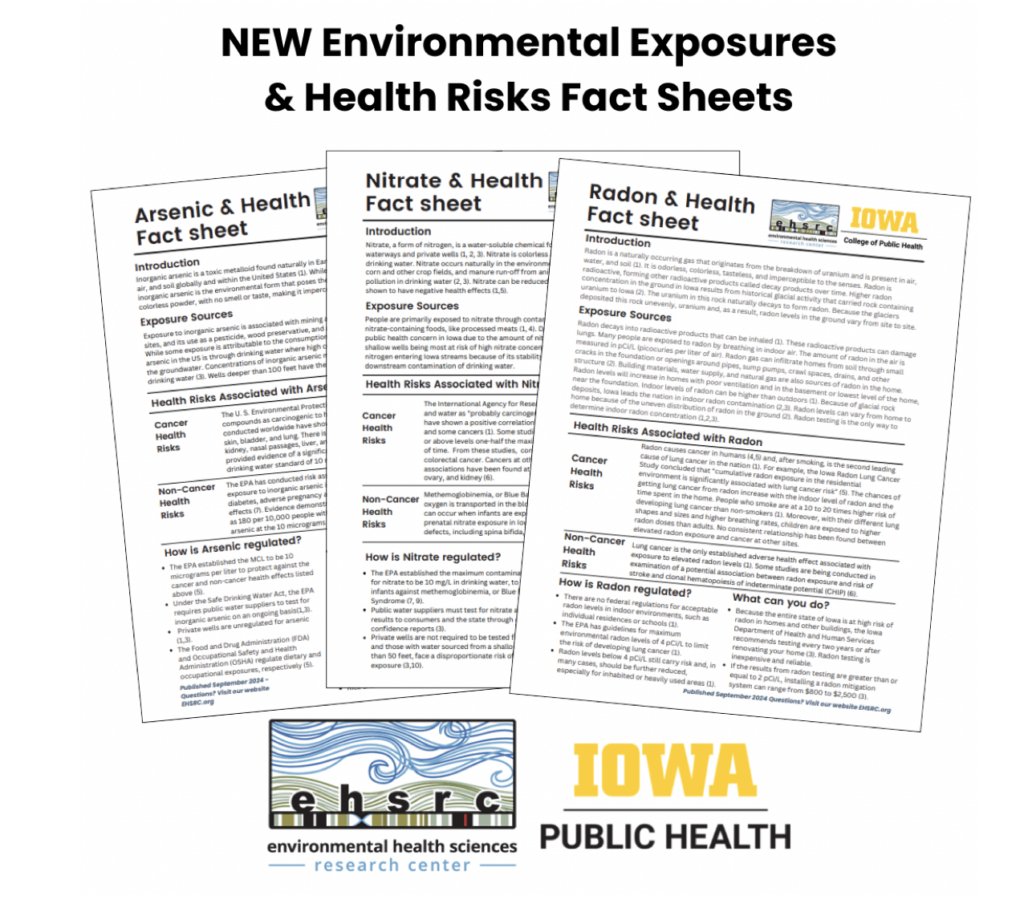
The Environmental Exposures and Health Risks fact sheets were created by the Environmental Health Sciences Research Center at the University of Iowa. These fact sheets have been made in response to concerns from community members about the connections between environmental contaminants and health outcomes such as cancer and other diseases. The packet contains information about arsenic, nitrate and radon. You can download them as a whole packet complete with an introduction, or as individual fact sheets. The EHSRC will release a few more fact sheets about other common contaminants in the coming months.
View them here https://ehsrc.public-health.uiowa.edu/communityengagement/resources-information/
All are welcome to join the Community Engagement Office Hours and chat about project ideas, questions, and best practices in community engagement. These virtual (zoom) meetings are an informal way to connect with others who share an interest in community engagement and public health research. Drop in for a few minutes or stay the whole hour!
Facilitated by Jackie Curnick, Brandi Janssen, Nichole Nidey, and Shannon Watkins
Dates/Times:
If you’d like to be added to the calendar invite and receive the zoom link for the December meeting, please email Brandi-Janssen@uiowa.edu
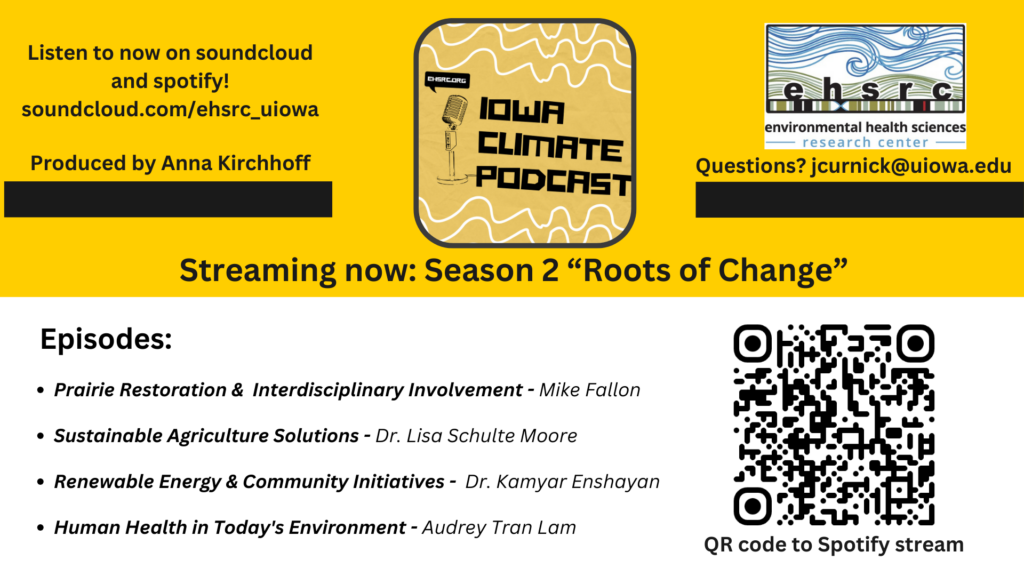
Stream season 2 of the Iowa Climate Podcast! This podcast was produced by the Community Engagement Core, including student intern Anna Kirchhoff.
Stream all episodes now on soundcloud and spotify!
Season 2 Episodes:
Info about Season 1 and the accompanying teaching curriculum is available here
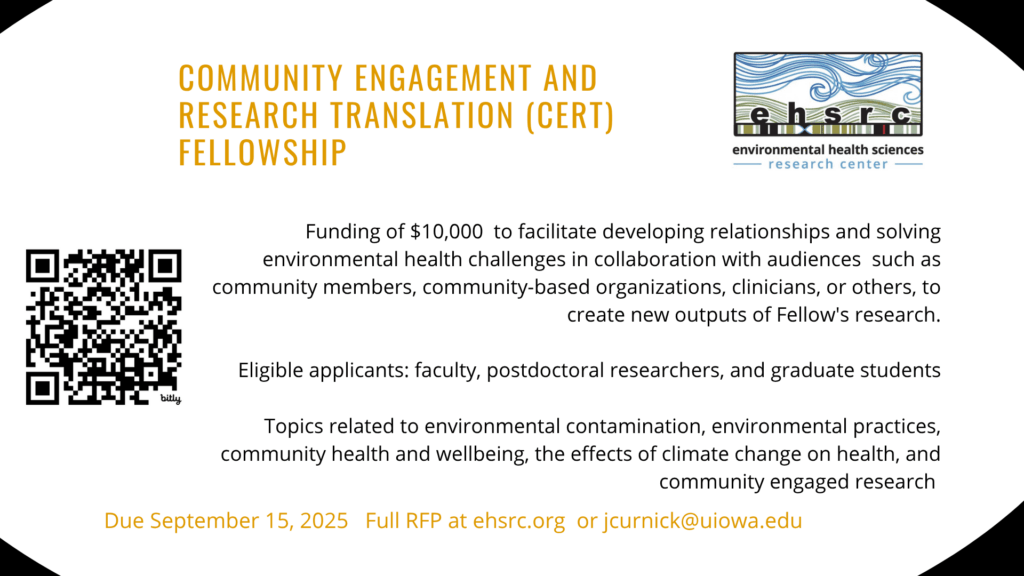
The EHSRC Community Engagement Core is conducting a regional needs assessment, and would like your thoughts! The 15 minute survey will be open until March 15th 2024. Please share with your colleagues and communities!
Eligibility: participants must be age 18 years and over and reside in the Midwest
As an incentive to complete this survey, participants can enter into a drawing to win $25.
https://uiowa.qualtrics.com/jfe/form/SV_7QB22Sb6WJQ7Szs
This survey focuses on environmental health, which relates to the relationships between people, their health, and the environment. Important issues include air, soil, and water quality, the effects of climate change and natural disasters on our communities’ well-being, and access to safe food and housing. The survey asks about “environmental health issues,” which means problems in the environment that can affect human health. This could include problems in the natural environment (soil, water, air) or the built environment (building materials, indoor air quality). The survey also has questions that focus on especially worrisome environmental health issues, such as natural disasters and climate change.
For questions email Jackie Curnick at jcurnick@uiowa.edu