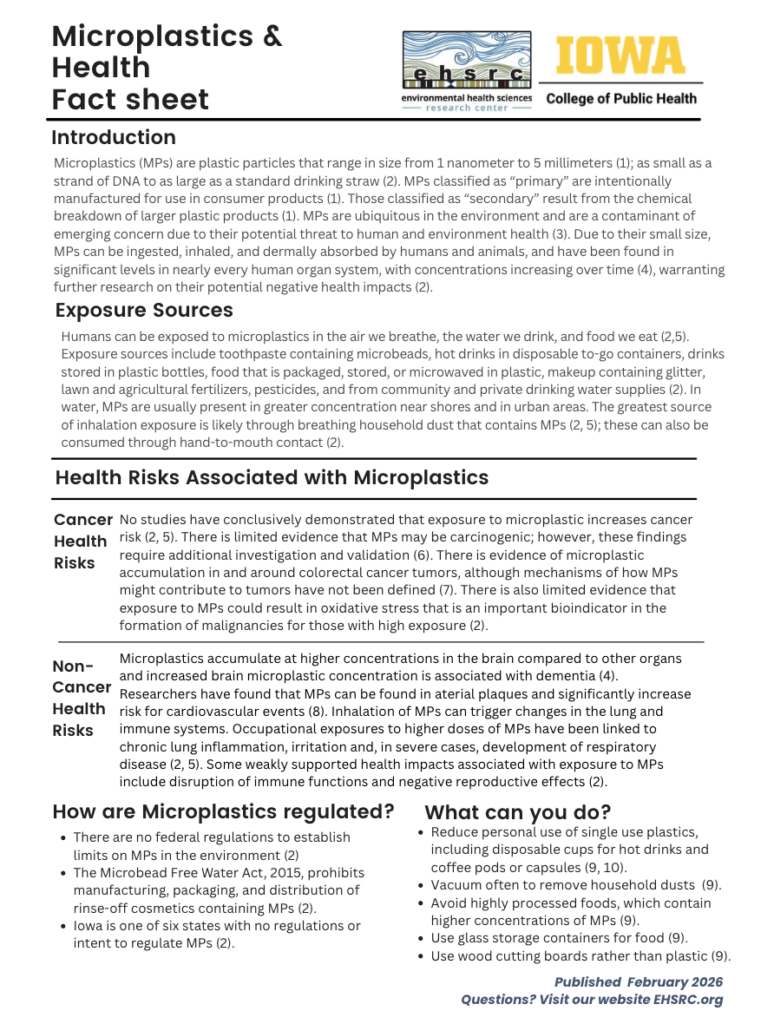
The Community Engagement Core has released a new fact sheet about health impacts of microplastics.
View the full packet and all of the individual fact sheets on the resources page.
Environmental Health Sciences Research Center
University of Iowa College of Public Health
The Community Engagement Core has released a new fact sheet about health impacts of microplastics.
View the full packet and all of the individual fact sheets on the resources page.

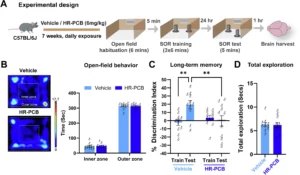
EHSRC Associate Member Snehajyoti Chatterjee, an Assistant Professor of Neuroscience and Pharmacology, led a study using spatial transcriptomic profiling to uncover the effects of polychlorinated biphenyls (PCBs) on gene expression related to spatial memory, a relevant factor in cognitive decline. The study, recently published in Molecular Psychiatry, a journal published by the Nature Publishing Group, found that mice exposed to PCBs exhibited deficits in long-term spatial memory.
To examine the molecular effects of PCB on the brain, the team used a spatial transcriptomics technique to analyze gene expression changes in five brain regions: the hippocampus, neocortex, thalamus, caudal putamen, and fiber tracts. Their analysis of spatial gene expression revealed the molecular signatures influenced by PCB in these susceptible brain regions of mice. Network analysis suggested that these changes are associated with higher chlorinated PCBs present in the brain. Additionally, the team showed that PCB exposure disrupts the expression of tight junction proteins, which are crucial for maintaining the integrity of the blood-brain barrier (BBB). Thus, the study results offer mechanistic insights into how PCB exposure affects brain function and cognition.
The Community Engagement Core conducted an Environmental Health Needs Assessment to drive our programming to meet the questions and concerns of our community members. The results are posted below:
Slides from IPHC Conference IPHC 2025
Due February 6th 2026 – The Science Cafe is a program that connects UI researchers and experts with Iowa community members. These one-hour events take place at a local coffee shop in Mt. Vernon, IA (about 30 mins from Iowa City) are structured around a presentation and group discussion about various environmental, health, and scientific topics.
https://uiowa.qualtrics.com/jfe/form/SV_bq1LoK0QzwWYV4W (Fill out this form by Feb 6th) Eligibility: Faculty, staff, and graduate students at the University of Iowa
The Science Cafes are usually on a weekday from 5-6 pm. The structure of the event is 30 min talk by presenter (no slides are used but there is a paper hand out), 25 min discussion/Q+A, Dr. Brandi Janssen facilitates the events.
Questions? Email Jackie Curnick jcurnick@uiowa.edu
Visit the science café webpage https://ehsrc.public-health.uiowa.edu/communityengagement/science-cafe/
Topics that have been directly requested by the Science Café participants on evaluations: (though you can propose any topic)

Iowa Climate Statement 2025: Climate Change Fuels Higher Insurance Costs
Read the Iowa Climate Statement 2025
Press release: Iowa Climate Statement 2025 News Release
Click here to view media coverage of the 2025 Iowa Climate Statement.
For questions email rose-phillips@uiowa.edu
As of 2025, the EHSRC no longer supports the Iowa Climate Statement with federal funds.
Iowa Climate Change Statements:
Iowa Climate Statement 2024: Individual Actions to Help Solve the Climate Crisis
Iowa Climate Statement 2023: It’s Time to Tap Iowa’s Vast Solar Energy Resources
Iowa Climate Statement 2022: The Many Benefits of Our Trees
Iowa Climate Statement 2021: Strengthening Iowa’s Electric Infrastructure
Iowa Climate Statement 2020: Will COVID 19 Lessons Help Us Survive Climate Change
Iowa Climate Statement 2019: Dangerous Heat Events Will Be More Frequent and Severe
Iowa Climate Statement 2018: Extreme Weather Events
Iowa Climate Statement 2018: Designing Buildings and Communities for Iowa’s Future Climate
Iowa Climate Statement 2017: It’s not just the heat, it’s the humidity!
Iowa Climate Statement 2016: The Multiple Benefits of Climate-Smart Agriculture
Iowa Climate Statement 2015: Time for Action
Iowa Climate Statement 2014: Impacts on the Health of Iowans
Iowa Climate Statement 2013: A Rising Challenge to Iowa Agriculture
Iowa Climate Statement 2012: The Drought of 2012
Iowa Climate Statement 2011: Climate Science and Public Policy in Iowa